
Stutter attempting go over 3k rpm and tachometer all over the place (may be related?)

Energy One

mleach72

Well-Known Member
I only adjusted the idle speed since, after the hose removal, the low idle was making the tachometer flash red and yellow until i opened the throttle a tad.

How should I adjust the gold "+" idle mixture?
Believe it or not, you are probably running lean at idle after fixing the leak. This is what happened when I had a manifold leak. After fixing the leak, I figured I would have to lean the mixture because the motor is getting less air. The opposite was true. Fixing the leak caused a greater vacuum through carb. The motor was now getting more air. I had to richen the idle. This would explain your rpms dropping.
Now that you have removed the vacuum from the motor, both lines are now acting like regular breather lines. If you are going to run it that way, I would suggest getting longer hoses and running them to the ground. Without the vacuum from the manifold, they may spit oil on you motor and carb.
 

Attachments

LHS

Active Member
Supporting Member
Had to go back out to the SHOP and look at My aircleaner seeing that picture and thought what the heck is that on my air cleaner LOL it’s just a reflection of the trusses in the shop
 

SEAL-rider

Active Member
It looks like those thunderjets are like $70 with free shipping.
Can't be that hard to put in, or can they?

One other thing I noticed is this breather dohickey emanating from the rear cyclinder. It wasn't on the 107 and the mechanic said the 117 needed it, forgot the rationale. Could that be contributing to this issue?View attachment 69693
Thunderjet is not needed. I had one, loved it. But, it comes with risk of line leaking and pouring gas all over. I later found it was simply not necessary. Proper jetting did the trick. Also I was told that those breather lines have a secondary function of balancing pressure to the front and rear of the carb. Stick with the original stock setup, get that right and everything will be great - unless you have an underlying issue. I see you have TP boxes, did you determine that you don't have EPA valves before you switched to the G-carb?
 
  • Like
Reactions: LHS

mleach72

Well-Known Member
Technically, all big dogs have epa valves. 2" intake valve are standard size on s&s heads and crate motors. Big dogs '06 and newer have 1.94" intake valves. '05's were slightly smaller at 1.90". It's hard to call either of these epa valves though, as they are still considered oversize valves. Harley used several valve sizes, but none were bigger than 1.84". Installing 1.90 valves is a part of a lot power packages for the evos and twin cams.
The smaller valve on the 05's probably does cost you a couple top end hp, but that wasn't the big problem. The restrictor plates were the big problem. I think I remember hp ratings for stock 05's somewhere in the mid 70's. Disgraceful! That's why the e carb was used. With the restrictors in place, the e carb was more than capable of meeting the engine's demands. Using the g carb would have gained nothing and probably would have lost some torque. When BDM realized that the g carb was still under the new epa regulations, they went back to it. Installing the g carb and manifold should have easily gotten you into the 90's hp.
 

No H2O

Active Member
Technically, all big dogs have epa valves. 2" intake valve are standard size on s&s heads and crate motors. Big dogs '06 and newer have 1.94" intake valves. '05's were slightly smaller at 1.90". It's hard to call either of these epa valves though, as they are still considered oversize valves. Harley used several valve sizes, but none were bigger than 1.84". Installing 1.90 valves is a part of a lot power packages for the evos and twin cams.
The smaller valve on the 05's probably does cost you a couple top end hp, but that wasn't the big problem. The restrictor plates were the big problem. I think I remember hp ratings for stock 05's somewhere in the mid 70's. Disgraceful! That's why the e carb was used. With the restrictors in place, the e carb was more than capable of meeting the engine's demands. Using the g carb would have gained nothing and probably would have lost some torque. When BDM realized that the g carb was still under the new epa regulations, they went back to it. Installing the g carb and manifold should have easily gotten you into the 90's hp.
The G-carb and matching intake manifold does make the 05 faster but not as fast as the 04 Ridgeback with the 107
 

mleach72

Well-Known Member
The G-carb and matching intake manifold does make the 05 faster but not as fast as the 04 Ridgeback with the 107
I don't doubt it. The 107 was just a better motor, pre-epa. Bigger valves, higher compression, and many came with a 600 cam. The BDM 107 was very close to a s&s 107 crate motor. To get a 117 up to s&s specs requires a lot of work.
 

john sachs

Well-Known Member
The G-carb and matching intake manifold does make the 05 faster but not as fast as the 04 Ridgeback with the 107
I do a shit load of S&S heads, 117" and up to 145." On the EPA 117", 4 I/8" bore S&S engines they have 1.940" intake valves, and 1.575" exhaust valves. I haven't worked on any TP heads, and won't, when they're used on the 117" S&S engines. The valve train geometry of the TP Heads on a S&S 4 1/8" is absolutely horrible., and sooner or later will cause MAJOR problems.
The big power loss on the EPA 117" S&S engines is: 1- No real quench area, because the pistons are .040" in the hole, and those engines are built with relatively thick head gaskets. 2- EPA camshaft. 3- Valve sizes too small for a 117" engine. 4- E carb too small for the engine when equipped. 5- Some of the shit A/Cleaners people use. 6 - Some of the worst exhaust systems available to make the bike look ???. :oldangry:
When all of the above problems are solved, IMO, then it's time to fix breather systems, venting the engine, jetting, etc.
They're a lot of owners on this forum that have solved the problems.;) Picture = a couple of weeks worth of S&S heads to do. 143 X 2, 124, 117.
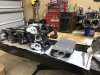
John
 

Attachments

Last edited:

mleach72

Well-Known Member
I do a shit load of S&S heads, 117" and up to 145." On the EPA 117", 4 I/8" bore S&S engines they have 1.940" intake valves, and 1.575" exhaust valves. I haven't worked on any TP heads, and won't, when they're used on the 117" S&S engines. The valve train geometry of the TP Heads on a S&S 4 1/8" is absolutely horrible., and sooner or later will cause MAJOR problems.
The big power loss on the EPA 117" S&S engines is: 1- No real quench area, because the pistons are .040" in the hole, and those engines are built with relatively thick head gaskets. 2- EPA camshaft. 3- Valve sizes too small for a 117" engine. 4- E carb too small for the engine when equipped. 5- Some of the shit A/Cleaners people use. 6 - Some of the worst exhaust systems available to make the bike look ???. :oldangry:
When all of the above problems are solved, IMO, then it's time to fix breather systems, venting the engine, jetting, etc.
They're a lot of owners on this forum that have solved the problems.;)
John
I'm not disagreeing with you John. Yes the epa motors have the 1.94 valves. Big inch crate motors from s&s come with 2" valves standard.
 

john sachs

Well-Known Member
I just put on a G carb on my 05 bulldog, was it the right thing to do?
Short answer: It depends on what else was done to the engine. Just putting the "G" carb on a STOCK EPA 117" Big Dog engine will cost you low end power and torque. It will however move the power band to a higher RPM. You may gain 2 or 3 more H.P. up stairs, if it's PERFECTLY tuned.
Also, IMO, a Thunder Jet on a modified engine with a "G" carb is a +++.
John
 

mleach72

Well-Known Member
Short answer: It depends on what else was done to the engine. Just putting the "G" carb on a STOCK EPA 117" Big Dog engine will cost you low end power and torque. It will however move the power band to a higher RPM. You may gain 2 or 3 more H.P. up stairs, if it's PERFECTLY tuned.
Also, IMO, a Thunder Jet on a modified engine with a "G" carb is a +++.
John
I agree with you John, if you were just going from the E to the G, but when you switch to the G carb, you get rid of the restrictor plates. Because of this, I think this change adds more than 2 or 3 hp. I don't know exactly how much power was reduced by the restrictors alone, but it had to be significant. The restrictors are much smaller than the intake ports on the heads.
 
Thanks guys the restrictor plates have been removed and I have large radius V&H exhaust along with the S&S Dual Runner intake.
Trying to get the jetting right now. Hope the G was worth it.
 

mleach72

Well-Known Member
Thanks guys the restrictor plates have been removed and I have large radius V&H exhaust along with the S&S Dual Runner intake.
Trying to get the jetting right now. Hope the G was worth it.
31/78 seems to be the most common here. I would start there.
 

Sven

Well-Known Member
Stutter attempting go over 3k rpm and tachometer all over the place (may be related?)


This may be unrelated, but if someone searches for the same tach/stutter, I have a gas gauge needle/carb stutter post. The short story is; the nephew rides away after he crashed the bike and repairs were made. In between, he has some guy that does extended bar wiring and he wanted cleaner connector ends than what the OEM was using. I took care of the crash work. The bike starts and he rides away. Comes right back and says it's not running right. I take it for a ride and wow, it sure felt like electrical and can fool you being fuel related.

I tell him I am not about to touch the guy's work so take it back to him. Meanwhile, the guy forgets to add the fuel gauge wires. I simply added a remote ground and a hot off a breaker fuse. That's when the nephew pointed out how the tank needle was jumping. Running, it would flutter like a lie detector needle on steroids.

Come to find out the guy did not ground his own ground harness to bare metal. Turned the key on and the needle swung to full and remained steady. Started the bike and the needle never moved. So you figure it was a bad ground up to the switches and tach using the ground from the main wire harness going up to the headlights, meters, etc.

And to point out something else the guy found, was the metal weaved ground strap under the frame was. You figure that strap was hanging before the crash and was unrelated to the... 'WATT was the last thing done to the bike?'
 

No H2O

Active Member
In my case the sputter was reproducible at ~3,000 rpms.
Mechanic adjusted the carb and it's pretty much gone now. If it happens, it's random, slight, and infrequent
 
Top