And the dog had been running so good

Energy One

BadBrad

2005 Pitbull
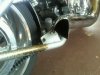
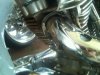
I was thinking the dog was ready for cross country as good as it's been running lately, then came today. Rode to work, 30 miles and all smiles. Rode home and slowed to pull down the drive and I could tell the compression all of sudden changed. I felt something hot on my foot. OIL!!! I killed the motor and coasted down the drive. Oil is pouring out the exhaust:bang:. I pulled it inside to cool down an it's obviously coming from the rear cylinder from the oil near the exhaust. So, knowing it's coming out the exhaust, any ideas what would cause such an extreme turnaround? I'll start tearing into it tonight. Just hoped someone might have some idea of what I need to be looking for. IMG00340-20110803-1603.jpg

IMG00341-20110803-1604.jpg
 

woodbutcher

Mr. Old Fart member #145
Staff member
i would start by looking at the rings.

after looking at the photos, could just be a rocker box gasket.
 

BadBrad

2005 Pitbull
How could a rocker box gasket allow oil to come out the exhaust? If it were all just coming from around the exhaust, then I could hope for the best. One of the pics shows oil all down the back part of the frame and the inside of the exhaust is soaking wet with oil.
 

erldawg

Guru
That's not good. I would look at simple things first...as woodbucher suggested gaskets etc:

Did ypu pull the spark plug and see what it looks like?
 

john sachs

Well-Known Member
Brad,
Before you start taking things apart, :down: look over the whole motor,and eliminate any gasket, seal or breather problems. Then do a compression test. After that, a leakdown test.
If it passes all that, then look at the valve seals and, guides. :eek:
John
 

Justintime

Member
With the loss of compression and oil in the exhaust pipe I would say head gasket or valve guide. Hope it's something simple!
 

BadBrad

2005 Pitbull
I'm too low on oil to turn the motor over. I'll go pick some up, fill er back up and do a compression test and go from there. Never heard any internal noise, no rods knocking, nothing metallic. I'll let you know how the compression comes out. What is "average" compression for each cylinder? Stock heads and cylinder.
 

Dakotabos

Well-Known Member
Calendar Participant
Troop Supporter
Mine did the same thing when the Ring let go :bang: Good luck in your troubleshooting and rebuild Mine was an easy fix just took money and time

My oil ring was fine bu the other ring was in 50 parts

I replaced piston rings honed it and replace the stud bolts
 

what?

Active Member
use to burn up rings routinely on my dirt bike back in the day. same thing would happen..........huge loss in power although the motor would still run. no compression equals no seal between the piston and head.

hopefully thats all it is. good luck
 

BadBrad

2005 Pitbull
I'm not sure what "normal" compression is, but here's what I have. 110 on the rear and 118 on the front. I'm also not familiar with the leak down, but I'm assuming that means to watch the compression guage to see if it "leaks down". Both cylinders hold steady. There is no oil coming out of the breather. Suggestion, comments or lets just drink a beer and think about it?
 

woodbutcher

Mr. Old Fart member #145
Staff member
if yours is the '05, it will have a lower comp. ratio. 110/118 isn't that far apart and was thinking should be around 125-130 (don't quote me on that). def. check the valve guides.
should be worse than that.
 

BadBrad

2005 Pitbull
What did the plugs look like?
The plugs were as expected with all the oil coming out the exhaust, wet with oil. Both of them. When I turned the motor over to run a compression, no unusual noise (like parts of rings grinding the walls). It wasn't but a month or 2 ago I swapped over to S&S rocker boxes/roller rockers and replaced one valve guide at that time. The others looked good. But, looks like I need to pull the rocker box covers and have a look see.
 

Little-Boo

Well-Known Member
Troop Supporter
Got this from Biketalk.com

Your numbers look weak, hope this helps.

With a warm engine, turn off the fuel from the tank, make sure the choke is off and the transmission is in neutral. Remove both
spark plugs and insert the gauge adapter in one spark plug location. Now, holding the throttle wide open, turn on the starter motor
and read the pressure indicated on the gauge. Then repeat the procedure on the other cylinder. The figures on the next page give
some idea as to the significance of different pressure readings. Also some gauges have a rubber tip instead of a screw in adaptor.
Either way, reading the static pressure of your engine should be fairly easy. Generally, higher static pressures mean more
torque at lower RPM ranges but the trade off is that above a certain point (around185 PSI) the risk of detonation enters the picture. What happens at higher RPM is less predictable and can’t be easily determined from a static pressure reading. What is important is that the cam timing, duration and compression ratio all be properly matched so that each compliments the others.

ENGINE TUNING INFORMATION

STATIC COMPRESSION AND ENGINE TUNING


When installing cams with high lifts and long durations, a few general observations are worth keeping in mind. Remember that additional cam duration can produce more usable power but too much duration may actually hurt overall performance. The problem of poor engine response begins when too much duration results in lower cylinder compression pressure (at low RPM) which in turn can reduce low RPM torque and power. Too much duration in a camshaft is not necessarily a good thing.

Static Compression Pressure Ranges and Engine Performance:

Less than 115 psi: poor low speed response, hard starting. Pistons and cams well not matched or worn rings, valves.
125 to 145 psi: OK for stock or modified street motors. On the lower end of the best range for a stock motor.
145 to 165 psi: OK for modified street motors. Static pressures in this range will be best for stock street motors.
165 to 180 psi: Marginal for large displacement street motors, possible hard starting, detonation and overheating.
Over 180 psi: These are high performance numbers. Street motors over 185 PSI may need compression release.
The above numbers are not absolute but the point is that static compression is important. Proper matching of cams and compression ratio will allow engines to be modified for more performance and still run smoothly in street engines.


Carlos

 

BadBrad

2005 Pitbull
I'll give it a try. All I did before was pull one plug, screw in the pressure gauge and turned the starter over. Didn't give it gas and didn't have the other plug out. If the pressure holds like it did a while ago, shouldn't that mean that the valve guides are tight? I put the plugs back in, cleaned off the oil and fired it up to see if I could see any leaks. After the oil in the pipe finally burnt off, it didn't smoke at all and compression seemed back to normal. I drove it down the driveway and back. All appeared to seem normal. With that being said, I want to ask this. The bike only lost compression and spewed oil for about 10 seconds, just before I pulled into my driveway. To me, it didn't seem to spew a whole tank of oil, yet the tank was damn near empty. Assuming my low oil light didn't come on and the oil pump sucked air, could that cause the symptoms I had? How many ways are there for oil to come out the exhaust pipe? It may be that I would need to ride it longer and heat the motor up more to replicate what happened. Just asking.
 

BadBrad

2005 Pitbull
Carlos, Using that technique, both plugs out, fuel off, throttle wide open and test one cylinder at a time, both cylinders registered 185psi. Is this the method used when someone asks you to check your cylinder pressure? I've always pulled one plug, no throttle and turn the starter.
 

Relic

Active Member
I may be crazy but I'd be looking at a breather issue / case over presurized. Problem is you said the breather was clean (I assume the intake was also clean inside).
 

BadBrad

2005 Pitbull
I may be crazy but I'd be looking at a breather issue / case over presurized. Problem is you said the breather was clean (I assume the intake was also clean inside).
That's kinda what I was thinking when I asked about the oil pump sucking air. Could that over pressurize the head and cause it to force oil into the cylinder? I just don't think I lost a full tank of oil in that little time and it's been over a week since I checked it. I'm thinking I let it run low and somehow that caused the problem. That's what I'm hoping anyway. Before i go to tearing it down, I want to try and see if that's possible. Otherwise, I'll wait till Rocky can be on standby with a trailer and I'll ride it for a while and see what happens. If it happens again, I'll have her come rescue me....again.
 
Top