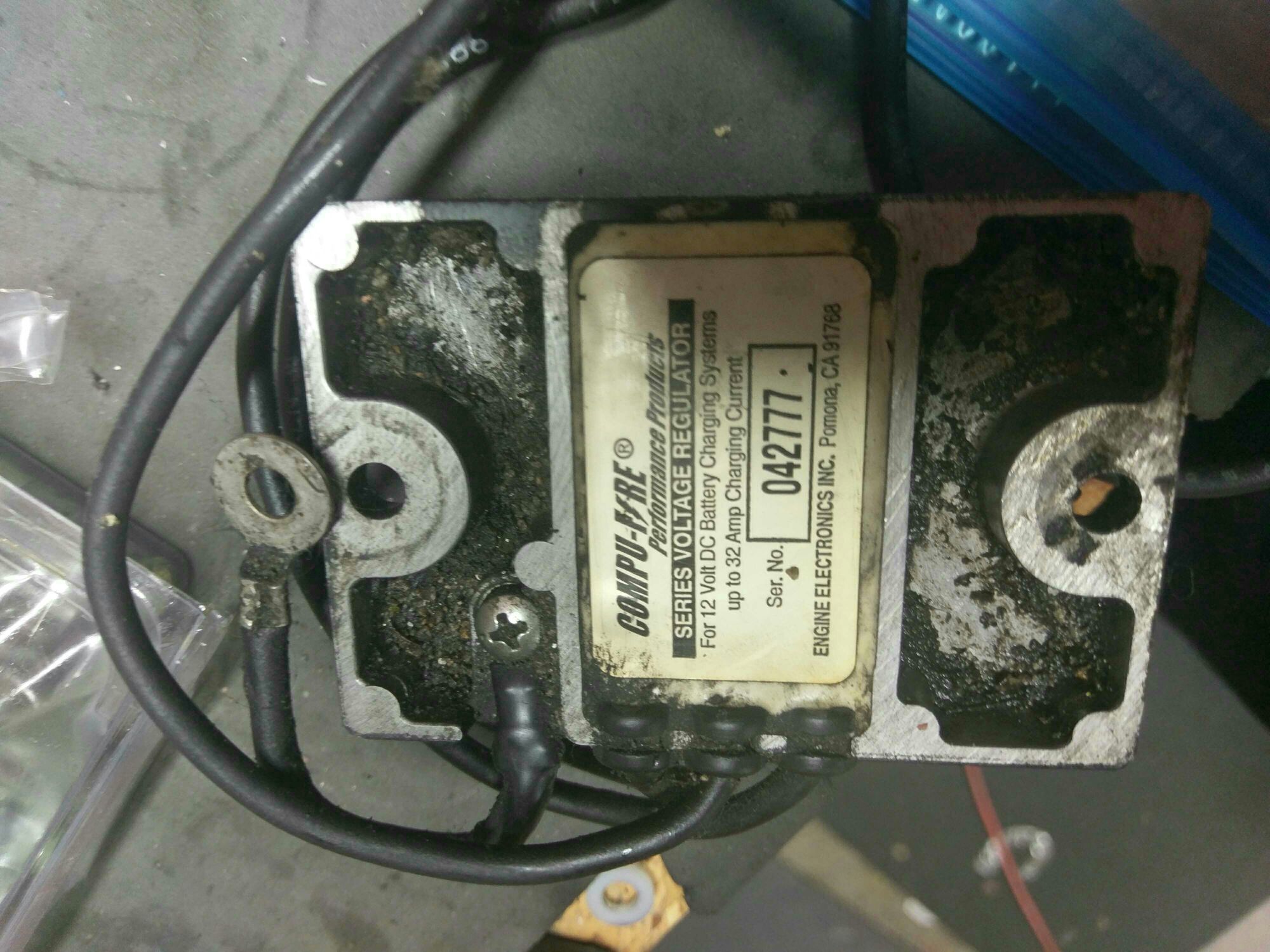
Smoke and fire at Voltage regulator

ground pounder

Active Member
Get a cycle electric voltage regulator which is not the shut type regulator. Lost 2 regulators before i got smart and got the cycle electric one. The stock regulator went up in flames and the drag specialties one started over charging bad. Put in the cycle electric one and haven't looked back! It has been on the bike for 5 years. Knock on wood.
 

cdogg556

Guru
Huh, sounds like the wires from VR shorted near the battery, that would melt the wires and the stupid fuse does nothing to prevent that. The start of the chain reaction may well be faulty VR pushing 19+ volts. If that is the case you are lucky you didn't burn the EHC. Now you should go thru all the other wires to make sure there is no more burned wires waiting to short out. Seems you might be lucky enough and your battery was able to steady the current to manageable level. Huh!
Or this is all BS and I was wrong again


Sent from my iPhone using Tapatalk
I am pretty sure that was the final straw on my EHC, after the VR fried the thing started freak'n out.
 

Threwithu

Member
So I talked to Curtis and he spent some time having me do some preliminary checks to ensure it wasn't my stator or some short in the stator. He also informed me that the to check my circuit breaker which the VR wire ties into before reaching the battery. Ordered a new 32 amp VR and should be here Saturday so hopefully this problem is due to a faulty VR..I am seriously hoping. Happy Thanksgiving
 

Threwithu

Member
I got my replacement VR in yesterday, and Im trying to find a suitable engine ground point to ground the VR too. Any of you who had to replace your factory VR, where did you attach the ground too? Thank you in advance
 

Th3InfamousI

Administrator
Staff member
I got my replacement VR in yesterday, and Im trying to find a suitable engine ground point to ground the VR too. Any of you who had to replace your factory VR, where did you attach the ground too? Thank you in advance
I actually ran the ground back to the battery along with the hot wire. I think it's best for a solid ground, but you could ground it to the bolt which holds the VR on.

Sent from my 2PS64 using Tapatalk
 

Threwithu

Member
I actually ran the ground back to the battery along with the hot wire. I think it's best for a solid ground, but you could ground it to the bolt which holds the VR on.

Sent from my 2PS64 using Tapatalk
I was thinking that might work, but then they have a 18 inch long ground wire that comes with the unit, made me wonder ifit need to go some where else..thanks
 

BWG56

Guru
I see, that does seem odd though, why wouldn't you ground the housing internally so when you mounted it, it would ground itself. But then again for a fiberglass body, say on a car, you would need an external ground screw.
 

Th3InfamousI

Administrator
Staff member
I see, that does seem odd though, why wouldn't you ground the housing internally so when you mounted it, it would ground itself. But then again for a fiberglass body, say on a car, you would need an external ground screw.
That is how the original VR are wired they don't have that extra ground. Maybe that's how cycle electric does there's and compufire doesn't?

I thought it would be better to run the ground back to a true ground rather than a bolt that obviously collects dirt as you can see by the bottom of my old VR.
That's exactly how my vr is grounded to the frame no external wire

Sent from my 2PS64 using Tapatalk
 

BroadBand

Since late 60's
As far as grounding the motorcycle, S&S has some info of interest.

Copy & Paste follows:

Why Is My Engine So Hard To Start?
Hot street engines have not only gotten bigger, they've also gained compression. Advances in combustion chamber design and tuning techniques have made these monsters more tolerant of pump gasoline than in the past, leaving hard starting as their main problem.

The first step in making these beasts more manageable is to check cranking compression with a good screw-in gauge. S&S recommends 180-190 psi for street use, 200 psi for those who insist on pushing the limits. The easiest way to reduce cranking compression is to install a camshaft that closes the intake valve a little later. An engine with the recommended cranking pressure will deliver good power and throttle response but still be reasonably easy to start. Some engines, however, remain stubborn even with moderate cranking pressures. That's almost always caused by something outside the engine—a worn or binding starter or starter drive, a weak battery ,cheap or old cables, poor wiring connections, inappropriate ignition timing or overly aggressive advance curve, hydraulic lifter bleed-down, or an improperly spaced alternator rotor scraping on the crankcase, just to name a few of the culprits. Whatever the cause, there are several tricks for making a stubborn engine easier to start.

A simple wiring change to remove the lights from the starter-ignition circuit will deliver more current to the starter. The draw back, of course, is that the rider must remember to switch the lights on. It is also possible to wire the ignition and starter circuits separately and use the handlebar "Stop-Run" switch to deactivate the ignition. With the ignition switch on and the handlebar switch in the "Stop" position, all battery current will go to the starter. That gives it more power to get the engine turning, at which point the handlebar switch can be flipped on to activate the ignition and fire the engine.


Another trick that can be extremely effective is to run a second ground cable from the negative terminal of the battery to one of the starter mounting bolts. This reduces resistance between the battery and starter, again increasing current to where it is needed.

One last tip is to leave the throttle closed until the engine fires. Opening the throttle admits more air in to the cylinder and increases cranking compression— the last thing you want. With idle set at 1000 RPM, the engine should start with no throttle. Otherwise, pull the throttle back just far enough to get the engine to fire. Hard starting is a nuisance you shouldn't have to put up with. If your engine has 180–190 psi of cranking compression but remains hard to start, look outside the engine for the cause. If cranking compression is too high, lower your compression ratio or find a cam that closes the intake valve later.

 
Top