swapped out exhaust - do I need carb work now??

JWScarab

Active Member
Well, I got my bike back together and put about 60 miles on her yesterday!! :whoop:

Question is this - I used to have radius pipes that were wide open (and ear splitting loud). I just took them off and installed a new original 2:1 Kirker header that the 03's came with from the factory.

The bike still has get up and go from a dead stop, it pulls hard thru the gears.

BUT - it seems sluggish at mid range, like 3rd gear and 2200rpm and you twist the throttle without downshifting. With the old exhaust, it used to have torque and pull hard, but now its a long slow climb to higher rpm's.

Is this due to it needing carb work to match the backpressure of the exhaust?

I am totally dumb when it comes to carbs, jetting etc. Is there just an OEM spec I can get the carb rebuilt to and it should work fine because of OEM exhaust? Any input is appreciated!!
 
Last edited:

FrankBDPS

Well-Known Member
Joe, do what is in the carb tuning book Franco sent you. Be careful not to get too lean or you will be learning what melted pistons look like. I just put the Kerkers on my bike but it is still on the table and I haven't made any runs with it yet.
 

BadDawg Bill

Well-Known Member
You probably just need to adjust the carb settings. With more back pressure you will need to lean it out some more. If that doesn't fix it you may have to re-jet it. If you look at your plugs I'll bet they are black.
 

Sven

Well-Known Member
Question is this - I used to have radius pipes that were wide open (and ear splitting loud).
First, franco will have the polish decoder posted next so you can understand what I said. However, you said, 'ear splitting' so here are little clues to tuning things and understanding, flow, chemical reaction, speed of the event.
1. Flow: One is quiet, the other is loud. One restricts the noise, the other does not. One fills up a better cylinder charge-(loud), the other does not. These are a few differences of those changes to the pipe swap.

2. Chemical Reaction: One slows the air flow and the spent reversion, or, 'for every action out the port, there is a reaction back into the exhaust port = Backpressure.' Loud, that flow still says heat moves faster, so when loud is running, the [spent charge] flows faster out the port with less restriction. Again, the slow reversed also with the spent backed up. A fired off mix, mixed with fresh. That flow out the exhaust also sets the chemical reaction of more gas in the [newly charge] chamber, because the loud moved the fastest out; cleaned the chamber better; let in more fresh air; more oxygen-wink-wink! Look at the 2 chemical reactions of how much heat did you make: is HP. Slow and quiet makes less HP than loud.

3. Speed In-Speed Out: This is the exact same engine, same carb setting. All we are doing is holding a more/less restricted pipe; walking up to the exhaust ports; here comes quiet and think of how 'fast' that bubble comes out the port? All we did was change a pipe. The only thing I see happening is a speed of who leaves faster? With the less restricted flow, I have more gas with the exact same vacuum draw. How? When the exhaust closes, there is this term, 'overlap' where both valves are open and the chamber is cleaned of the spent charge this way. But if you pack too much and slow that flow, you chop down on the spent with the exhaust, not chop on half spent/half clean charge, man are you holding the ideal exhaust pipe. That says on intake; no carb change; same fuel content; same chemical to air is the same dose in the cylinder. Agreed? All I see now is the exhaust valve is timed to the same opening, right? The heat is speed out the port, yes? The unspent lowered the heat mixed with the fresh, no? The quiet keeps more mixed/spent air/unspent gas back up the reversion, yes? The quiet slows the bike down is a pipe change only. The loud is the better filled cylinder chamber and that is the difference, no carb mod enters the picture, but speed does.

The bike still has get up and go from a dead stop, it pulls hard thru the gears.
Answer. My take is speed: you pushing so hard out the pipe, we still have the same engine pushing that same feel. Look how the bike takes off from a dead stop. That is one fuel circuit to the next as in all 3 run up in a linear way and never shut off. Speed showed it still has the getup and go no carb change needed if anything it's rich so no harm no foul. And I mean it has to foul plugs rich. You show a white tip on the plug, that is not rich but, man that looks good. However, you need to look deeper to read a plug. Make sense now?

BUT - it seems sluggish at mid range, like 3rd gear and 2200rpm and you twist the throttle without downshifting. With the old exhaust, it used to have torque and pull hard, but now its a long slow climb to higher rpm's.
It has to explain itself so simply. Each step shows how the other step stepped, you step back or forward with the abstract. How simple was the pressure is pushing back in that chemical reaction in a slow rpm situation or fast. It still says, no matter the move, for every reaction, the spent is going to follow each stroke is pick an rpm. See, the action never stops but is linear at that exhaust port too. The bike is running with the quiet pipe and she cannot push out all that spent as fast as if slow in rpm too. That's the compromise, is the push back in. It is more how quiet works and said performance. Loud is the open door so it's going to have a more powerful charge and that means torque. It sped up faster with more heat to convert. The quiet is there with that for every mix, one is more powerful if loud. And every constant fuel to air mix into that chamber is a constant. It is about to show itself. Which intern shows the pipe change.

Is this due to it needing carb work to match the backpressure of the exhaust?
There is this simple yet very explainable way to say backpressure and see it. This is where the concept begins, you lay out the abstract from there. An engine without a pipe says, how did that bike run both ways no jetting needed? That engine is tuned, period. What happens next is: flow is [for every action] a problem; the chemical reaction is next; the speed out the tailpipe are 3 bandits like: fuel/spark/compression and that balance factor. I'm old so I may be missing one or it's so absolute like sparky and his buddies.

What is the pressure in the garage, on the tools, up the pipe, in the chamber, the bike is not running in the garage? 14.7psi.
What is the pressure trying to get back in at the end of the pipe we start the engine? 14.7psi.
What is the pressure inside the normally aspirated cylinder chamber> right before compression? 14.7psi
What is the answer, you cannot create or destroy the bubble. All you did was; kinetically compress it; chemically heated it; caused a bubble to expand robustly, and it went right back to? 14.7psi.
What is the chemical reaction of a spent vs. clean mixed fuel to air; and that air to fuel ratio is the x-ray inside that bubble; and the bubble you captured inside that chamber you are looking at is? 14.7psi.
What is the speed; no matter the speed in; is the cylinder chamber filled with; before compression happens? 14.7psi.
What is the first tuning number does a tuner tune off of, and finds the perfect AFR mix to that certain engine? 14.7psi: {ideal (stoic) emissions turns to harmless vapor, correct?]
What is the Penultimate number a turbo or blower engine is creating over a N/A engine? It has to hold in a certain number first, before the boost gauge shows a boost off of over? 14.7psi (1 atmosphere)

I am totally dumb when it comes to carbs, jetting etc. Is there just an OEM spec I can get the carb rebuilt to and it should work fine because of OEM exhaust?
No you're not totally out of the loop: it's boring theory you have to work out. You need to watch the bike talk to you first. The concept is this Penultimate number and it's called 14.7psi. The rest is using the [polish conversion] abstract to explain it. There is no book to explain this so you need to see the 'speed.' Does my bike start right up and idle? Yes. That means a clean carb and all 3 circuits are working and open. How much cleaner is that if gas is a detergent and it's cleaning it chemically. Kind of makes sense, right?

Shift down one to remove the mid-range lag. This spins the engine up and out the ass comes the bubble. Takes a Man to ride a stock bike and know a performance bike is better performing. Takes a Man to keep the stock pipes on and knows there is still the same HP on tap. Takes time for the [HP] to sneak up on you is all. That's the change up unless someone can explain it better from hear is show me the spark plugs.

 
Last edited:

FrankBDPS

Well-Known Member
Hey Sven, don't the two into one pipes form a vacuum in the collector as the gas expelled from one cylinder passes out and helps the gas from the other cylinder to be extracted. In the end you still need to have the correct fuel air mix to get max hp and the best fuel mileage. Too rich fouled plugs. Too lean junk motor.
 

JWScarab

Active Member
Guys I've read all you posts carefully! Sven, I do understand your messages, and thank you! You always take the time to give thorough answers! I have not touched the air cleaner - its a K&N behind a Big Dog chrome cover.

So here what I did. I really like the look of the Kerker. So I took the baffle out! OMG. It was my open radius pipes x10 loud! Like drag pipes going into a megaphone....lol. So I took her out for a spin and pulled at the 2200rpm again. Felt maybe a tad stronger, but still needs higher rpm to pull hard. Im wondering if it really is running the same, and maybe I am being a little paranoid I am losing power. Anyway, I cant leave the baffle out- TOO LOUD.

So, I reinstalled it (piecing back the ripped up fiberglass...lol). It sounds SO much better! So now that that little trick didn't work, Im going to take your advise. Im going to take her for another run (going to be Wednesday before I can do it) and see how it feels again and if its just my imagination. Then Im going to pull the plugs. If they look good, Im going to leave well enough alone. Im so scared to death I will mess it up and go to lean.

If plugs are black, I will follow Francoblay1's links and put the carb back to stock. Actually - it seems pretty easy to do after reading it a few times! I will post results but it will be a few days.

Last 10 days have been working on the dog getting her on the road - now my family obligations are stacked up!

That XXX carb looks nice! Maybe a future upgrade! I've spent so much on the bike I have to give it a break for a bit or I will be divorced....lol.

Thanks again - you guys really help me a LOT!!!
 
Last edited:

Sven

Well-Known Member
Hey Sven, don't the two into one pipes form a vacuum in the collector...
Good question.
Here's my thought:
My pistons are 180° apart. That means I meet and greet the other pressure at some sonic speed, correct? I want to what? Push a pulse or neutralize a pulse? Push is friction, N is no pressure or goes neutral.

H Pipe = Gruntorque. 'Bubble backup' ~ Friction flow. Think funnel flow ~ Slow out. Example: Sportster stock exhaust or that long crossover pipe.
X Pipe = Air Dump. 'Bubble Blown' - OUThend. Think pulling the funnel away and pour directly into the container and watch how it fills the void now - Fast out. Example: When that oval cut is way down there and that is tied up in a more open cut, no pressure thru the tube but dumps into a huge hole N destroys the bottom grunt.

H = Hot rod from pole to pole in the streets.
X = Xtra fast out is the drag strip and that top end being the freed up friction.

Here's another thought:
Crankcase breather to air box. Why? The sonic intake whoosh and the crankcase pressure. Both are pressures and by tying those two in a sonic N setting. We are looking at the exhaust pipe as more a balance factor than thinking the H and X pipe changes the flow in grunt moves. I think that tie-in: addresses the sonic like the air box connection? Wink-wink! :2thumbs:
 

Sven

Well-Known Member
I am totally dumb when it comes to carbs, jetting etc.
To undumb, do the work. How do I read a plug? My porcelain is a full read from top to bottom.

Nose: I want to look for spots on the nose. If detonation occurs it melts aluminum if not cracks the piston apart to collapsing the crown, narrows the ring grooves, locks the rings from floating so the air can push the ring from behind, etc. and she's junk now. So when that happens, things explode or expand and gall. That exploding is the aluminum leaving some area, balls up, bangs like an electron after a proton, bangs off of that and moves on till the energy runs out or it runs out the exhaust or intake port. So that mess says, I want to see the ball hitting the nose it was cherry red and left aluminum on the nose as in a tiny dot a needle tip would leave or larger.

Bottom: Here is where the read is. Why? The nose is layered in carbon, be it black or tan. The real color is at the base of the porcelain:

Gray = Race tuned.
White = Lean
Whi-tan = He's the man!
Tan = getting rich
Black gray = too rich

Im so scared to death I will mess it up and go to lean.
:spank: I told you so. Did I not say do the work? I'm going to go cook my engine and check my plugs later. No you're not. Scared means, 'I'll check later.' Undumb means I look now and then say, 'I was scared for nothing.'

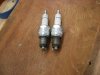
Gray nose = I am on the raggedge of burning this puppy up but if my nose is gray I'm a dead duck: det dead.
White nose = My nose is tan and my undies are this clean. I do not stop for gas I am so lean and mean.
Whi-tan nose = I am an old plug more or less with mileage and I am not oil fouled luckyou.
Tan nose = I am mileage happy at the nose read. So-so mileage but strong, smooth, grunt.
Black nose = Way too rich. I'd be more scared of a glowplug effect of some carbon spot and this is called, pre-ignition before the spark plug fires it.

That plug reader is a special tool so this nose read is the quick and dirty.

Signed,

Pay me now or pay me later for not listening-wink-wink go look before one more rpm.
 

JWScarab

Active Member
Pay me now or pay me later for not listening-wink-wink go look before one more rpm.
Very good point!! I will pull the plugs and look, then do the procedure in the carb tune info, then ride, then look again! I'm usually a little hesitant to touch stuff I have never done before but after I do its like - that was easy (ex: EHC replacement and Fork Seals - scared turned EZ)!

I'll check it first before starting her up, and adjust the carb before riding! I have learned my idle is too low. Im at 700-750, so that's going to 950-1000 asap!

Thanks for keeping me on track!
 

Sven

Well-Known Member
These plugs look GOOD (spot on!)!!! you got it :2thumbs:

:cheers:

Sven?
Gorgeous Looking. No oil, no carbon soot, not white hot. Looks like it runs fine like franco pointed out. What is the drive-ability like? Falls on its nose? Gets up and goes? Stumbles low rpm or stumbles high rpm? Clean throughout, then no need to retune.
 

JWScarab

Active Member
Thanks guys!! I did tune the carb right after I took those pics! It was SO ez to do!!! Thanks VERY much for talking me into doing that!

I took her for a ride and what a fking difference! It seemed to have a LOT of power!!! I know the plugs looked ok, but I think she was a bit lean. It did use to sneeze thru the carb before and the plugs look a bit whiter in person than the pics.

So now that its tuned it quit sneezing and it seems to run MUCH better!! It seems to run clean thru-out the ranges!!

I ended up at 1 3/4 turns out on the fuel air mix.

Thanks again!!! You guys are awesome!! :cheers:
 

Sven

Well-Known Member
I ended up at 1 3/4 turns out on the fuel air mix.
Spit at low rpm is lean. Spit at top is rich.


Im so scared to death I will mess it up and go to lean.
You should know me by now, I am not going to flat out give you the answer too many times. Figure it out yourself here you go. I walk up to a carb, I better know what I did when I turned the screw 1 3/4 turns out.

1. Main jet = Fixed.
2. Slow jet = Fixed.
3. Slide needle = Adjustable.
4. Idle jet screw = Adjustable.

I'm going to look at ANY CARB sideways, find the idle jet screw and know if I fed the fuel rich or fed the air lean.

A. Looking at that carb in that position, I can tell the idle mixture screw from an idle [throttle plate] lifting screw. Both have the ability to set the idle up or down. So if my idle jet screw is on the air cleaner side, that says I turned the air out leaner. On the air cleaner side, that air tunnel is heading up to the slow jet and is running the low jet's atomizing air-w/fuel from afar.

B. Looking at that idle jet screw again, and it is now positioned to the head's side or the intake manifold side, this is screwing out more gas, the hole on the air cleaner side is this 'patent copy loophole(?)' reverse the engineering of the atomization. So when I walk up to any carb, see "what side" the idle jet screw is positioned at, I know I just made an adjustment to the ________ Fill in the blank; side of the air to fuel ratio. What did my air to fuel adjust out to, rich or lean? I don't know, were is my air screw located?

C. Looking at changing out to a faster flowing muffler, I know I lost a little air to fuel ratio. I now think needle is my first move, not jet changes. I have 2 needles. The 1) is my idle adjust screw and 2) my main jet slide position needle. I know both feed in the linear as it starts/idles/mid/WOT's its way up the rpm range and no hole shuts off. Tune wise, I have two [adjustable] feeding tubes injected into the chamber.

D. Looking at how air to fuel can move the idle to stumble out of gas or stumble with too much gas, I am going to fine tune the muffler move and move more gas via the outside needle first. So my move is to find peak [high] idle with my idle jet screw. I find peak rpm and lower my idle plate screw back down. I then know that 'lean is mean' I turn the screw back in 1/8th turn from peak idle.

E. From there I can look at how my response is now? There is no more gas the engine wants before it stumbles, there is not enough gas is when the engine stumbles think. I have no AFR gauge as to where the air to fuel ratio is? I know my peak is ideal and may test from there. I am still safe backing off of peak 1/16th then. I'm not scared to leave it at peak. I'm getting somewhat scared going back to leaning it at an 1/8th turn in? I better think, if lean means less gas it hardly moved the rpm's, hello?

:hi:
 

JWScarab

Active Member
Hi Sven! Thanks very much!! This makes sense what you are saying. I really believe it is set right now. The 1 3/4 turns was set by going by ear, and going to the "middle" of the sweet spot in the way the engine ran. I started at 1 1/4, but then I started going both ways and I found the sweet spot. Then I went both ways slowly till is stumbled and then went back the other way till it did the same thing. Then I found the middle of that spot.

When I got all done, I turned it till it seated and counted the turns, but I put it right back to where it was. I just did this to see where I ended up with, and it was 1 3/4.

Thanks!
 
Top