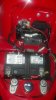
A generic deal with this is a loose wire = I hit a bump and/or let it idle. Both those bang and pulses took out a wire. Why narrow it down to a 'possible wire?' My thinking is if it was heat related it would not start right back up. If it was a faulty sensor it would fry by now and no longer start. However, this more sounds like it's wire connector bounces off, acts the kill switch to main power, or to spark, or to cam/crank sensor(s).
You figure the black box is nothing more than waiting for an input signal to send the output signal. To me, it sounds like the box is fine. So, is there an input failure to the black box? Or, is there an output failure to the final jobber, meaning, spark or fuel? WATT you can't sort of do is cause a different resistance to the input signal. So technically, if this bike had a backup system for the sensor, you'd want to run a test light/ohm meter to the wire input side. Why? You are trying to follow to see if the input loses current?
On the output side, you want to see if the test light/meter loses signal to the coil or injector? If you think it's the EHC, then that output [wire] side of the box, [you want to question] that puppy. So in a sense, you are looking at 6 basic wire connections:
1. Power wire source from (+) side = Starts.
2. The (+) source to the hot side of the Key lug = Ends.
3. The wire from the lug of the key going out to the next jobber = Starts.
4. The jobber has received this wire from the output side of the key = Ends.
5. The wire out of the jobber is connected to harness/other jobber = Starts. 6. The final output wire [for that loop] then travels to ground = Ends the complete cycle to (-) ground.
A. Input Signal: Did you lose power to the key or box? So the timing light would be hooked to the spark plug lead. This shows output has dropped, so the input at the cam or crank sensor needs to fail = IF it is on the input side.
B. Key switch: Did you lose power here? So a test light will remain on the battery side of the switch. Another test light will come out of the output lug of the key switch. If power is lost on the battery side = Loose battery terminals/loose battery, etc. If the current stays lit on the battery side of the key switch, but now the output test light from the key switch is off w/key on, did you catch that? You turn the key off, turn it back on and the test light from the output lug comes back on = Key Switch sort of narrows it down.
C. Output Reference Signal: So in a way, it is more like narrowing down two variables, meaning; input/output. We could more or less bleed off of the cam/crank/power input side and see what current was lost between input or power loss. On the output side, it is more or less you watching the fuel injector lose output from the black box, or the timing light; as the plug drops out. This more or less says, if my lights stay on, the bike dies, it's ignition related. If the bike dies and all is lost, it is the input side.
Make sense in the chase of [way too many] variables to narrow down?