
Odd Electical readings on Bulldog Grounds - Ideas?

chacha

Chaff Your EHC!!
Calendar Participant
Hey Guys;

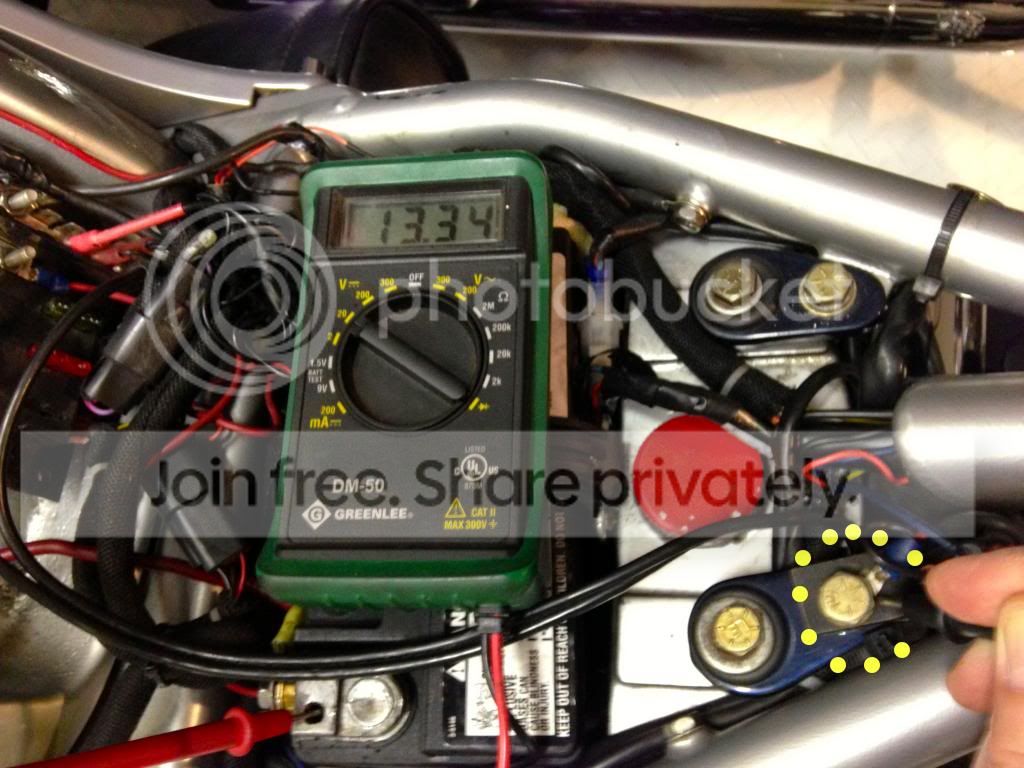
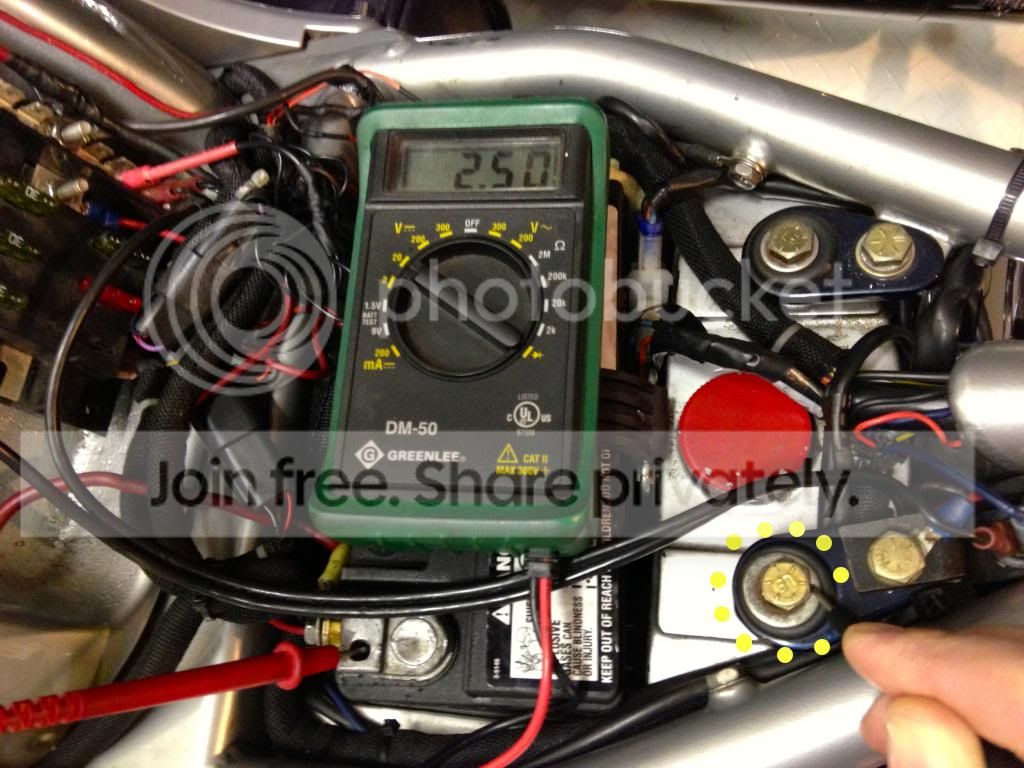
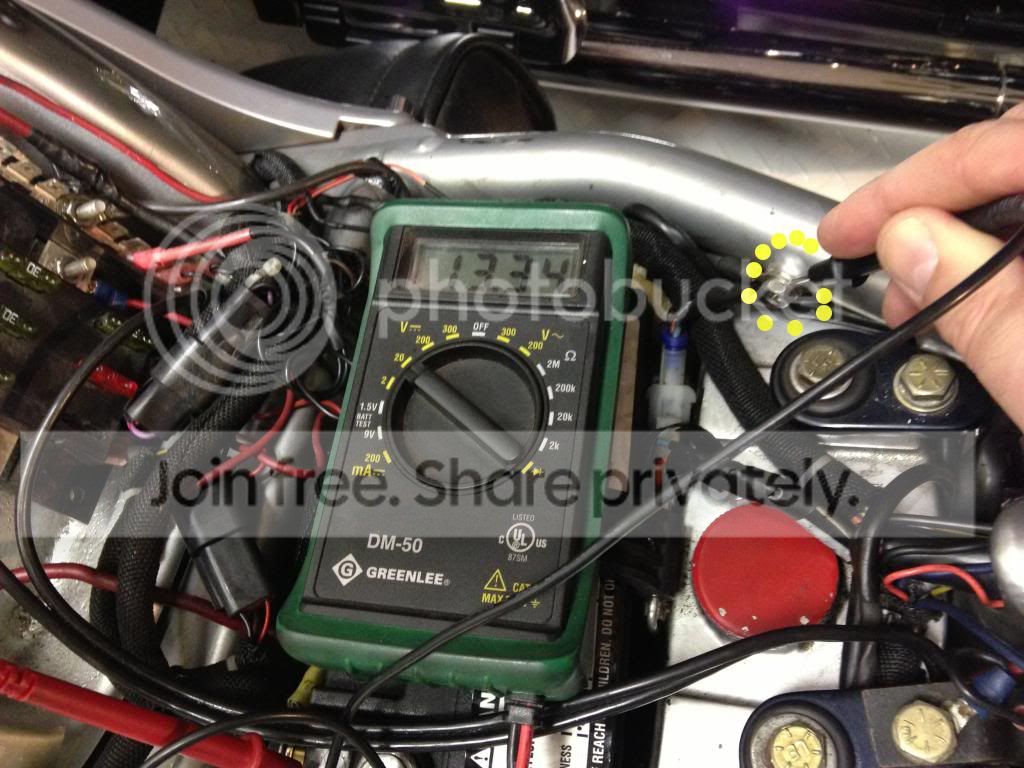
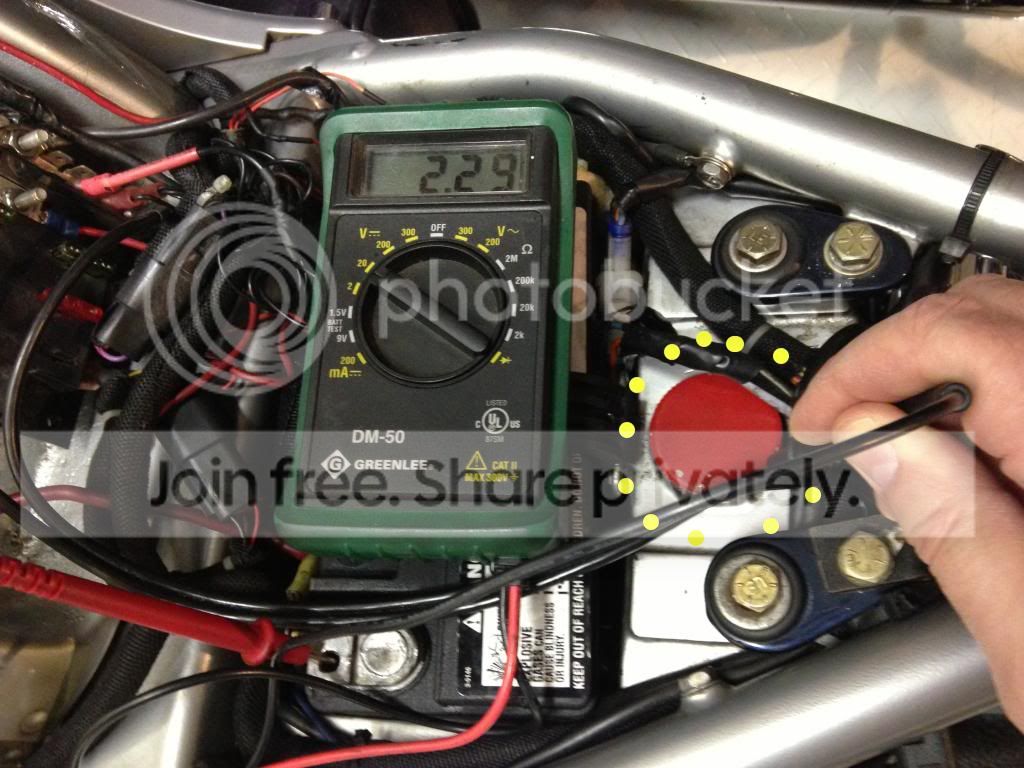
This is from a 2004 Bulldog with 30,000 miles and a WIRE+ harness. She's kept on a tender, but lugs through an initial start like the battery is weak. I started putting a meter on it from the Positive side of the battery to some points around the motor and frame. Most are fine showing >13 volts, but things connected to the oil bag are showing 3 volts or less.

Do I have a bad ground someplace -- is there some current leaking to cause a drain on the system?

All thoughts appreciated:cheers:

reading at the forward bolt connecting the oilbag to the frame

reading at the rear bolt connecting the frame to the oilbag

reading at the grounding lug

reading at the oilcap
 

bigdogtech01

Well-Known Member
Your trying to pull a reading on a bolt that's inside of a rubber welnut.
If your getting the correct volts out of battery, I would do a starter draw test. (knowing your battery is good, you may want to get it load tested)
 

ringo

Active Member
only use actual grounding points that are part of the circuit. It dont matter what the reading is going to the oil cap as it plays no role in the circuit.
 

Fibersnake

Banjo Playing PsychoBilly
Your trying to pull a reading on a bolt that's inside of a rubber welnut.
If your getting the correct volts out of battery, I would do a starter draw test. (knowing your battery is good, you may want to get it load tested)
Agree, those rubber isolation grommets will tend to let current flow as well as the metal to metal.
 

BigDogBro1

Made in the USA
Yep...Those are NOT good grounding points. The rubber isolators (INSULATORS) and other mounting points for the oil bag are not designed to provide a ground connection.

Pay no attention to those readings. You are only getting 3v because the oil bag has a high resistance connection through the oil bags poor mounting points and oil lines back to the battery+.
 

Nukeranger

Nukeranger
Andrew,

How do you do a draw test? I assume you are looking at amps. Do you look at the voltage drop? I have never even though about conducting a direct DC amp test for a starter because it is or could be (probably enough) to destroy an amp meter unless specifically designed for large DC amps with large cables.

Huw
 

Nukeranger

Nukeranger
Andrew,

How do you do a draw test? I assume you are looking at amps. Do you look at the voltage drop? I have never even though about conducting a direct DC amp test for a starter because it is or could be (probably enough) to destroy an amp meter unless specifically designed for large DC amps with large cables.

Huw
 

chacha

Chaff Your EHC!!
Calendar Participant
Thanks guys. Never intended to use those points for grounding...just noticed it and thought it was odd.

Still chasing down what I think is a current drain someplace in the system.
 

ringo

Active Member
if your meter has a current setting you can disconnect the negative battery cable and hook the meter up in series between the battery and cable. Current drains that slowly kill a battery are typically small, so you may see numbers like 0.6 or something. Start disconnecting things, when you hit the circuit the drain is in the reading will drop to zero.
If you have an inductive meter, you dont have to disconnect anything. Just set the meter and clamp it around the negative battery cable.
 

bigdogtech01

Well-Known Member
Andrew,

How do you do a draw test? I assume you are looking at amps. Do you look at the voltage drop? I have never even though about conducting a direct DC amp test for a starter because it is or could be (probably enough) to destroy an amp meter unless specifically designed for large DC amps with large cables.

Huw
Starter draw test is very easy and will not harm your voltage meter.
-Set meter on Volts DC
-Take one wire lead and hook to ground side of battery.
-Take other wire lead and hook to positive side of starter wire down on starter post.
-Now turn ignition on, watch for voltage reading and hit starter button.
-Voltage should not drop below 10 volts ( assuming battery is good and has been load tested )
-If voltage drops below 10 volts ( ex...8.5VDC ) your starter is most likely bad.
 

Nukeranger

Nukeranger
This only tells me the voltage drop not the amperage. You can simply go across the battery for the voltage drop. The positive connection to the starter comes straight from the battery and the ground doesn't matter where you measure (any ground connection from the negative terminal. It would be simple math to get the starter amperage assuming the winding resistance doesn't change when spinning the starter.

Considering all this, a lower battery voltage will indicate larger amps for a good battery.

Huw
 

Fibersnake

Banjo Playing PsychoBilly
To do a proper current draw (amperage) you will need a good amp clamp. YOu can buy a simple good clamp on one for not too much money and add to tool box for later use, or depending on your multimeter, one that will plug into the MM. Make sure you get one that reads DC and AC and that is rated for at least 100 amps or more.

Once you have one, clamp it around the positive cable or better yet around the power cable on the starter and crank and observe reading. For small current, most MM will read a couple of amps alone and if checking for small current such as typical in electronics, most good MM will be able to read milli-amps with no problem. Just make sure you have it set for DC current.
 

Nukeranger

Nukeranger
Most clamp on meters measure AC current which is great around the house. I have never thought about looking for a DC clamp on. I would not consider sending high current through a meter. Most meters have 10 amp fuses to protect the meter and the leads are not designed for the high amps that would be drawn by a starter. Of course you could put a big resister in parallel with the starter, measure the current through the resister and do some math.
 
Top