It will not go into “limp mode” , it will throw a fault for front and or rear cylinder “bad sites” and turn on the MIL.
I have never seen or heard one with 3 wire or narrower band O2’s
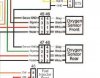
Mine and all I’ve seen, including the schematic are 4 wire wide band.
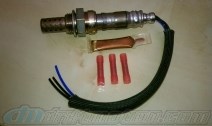
Here are examples of 4wire narrowband sensors
4-wire, High Quality Narrow band Oxygen Sensor. Standard Threads 18mm x 1.5, substitute for any Bosch or NTK sensor.

store.034motorsport.com
Denso Narrowband o2 Sensor with 18mm x 1.5
www.driftmotion.com
==
From
https://www.dynojet.com/blog/narrowband-vs-wideband-o2-sensors
Narrowband Sensors: The Guessing Game of Fuel Tuning
Narrowband sensors only know three things: lean, rich and stoich. Depending on the oxygen content it reads in the exhaust it sends a signal between 0 and 1 volt. 0 means too lean and 1 means too rich. The ECU, not knowing how far from stoich it is, overcorrects from lean to rich over and over until it eventually gets closer to stoich. The ECU determines where the closed loop is and where the narrowband sensors are active to be able to make these adjustments.
What our tunes do is optimize your air/fuel ratio outside of the closed loop, so even when the narrowbands aren’t active your bike can still be running close to optimal conditions. We also tune the closed loop area to ensure it’s running at stoich, this keeps the bike from needing to ‘learn’ over time to stay tuned accurately.
Narrowbands are excellent when it comes to finding 14.7:1, but they aren’t nearly as accurate when air/fuel reaches either side of this ratio.
Wideband Sensors: Supreme Tuning Capability
Wideband sensors are built for pinpoint accuracy. They send voltage to the ECU on a scale of 1 to 5 so that it knows exactly what is required to maintain target air/fuel ratios. No more guesswork. This also helps your ECU stay more accurate over time with smooth changes instead of the over corrections that narrowband sensors require.
Wideband sensors also open up the entire fuel table to the closed loop. This gives you absolute accuracy of air/fuel ratio at all times, even when you’re pushing your engine to its limits.
This is why nearly all
tuning professionals use strictly wideband sensors. It not only gives more control than a narrowband sensor could ever accomplish, but it also gives the tuner a wider range of accurate information under any drive conditions nearly every time.
=====
from
https://www.hhokitsdirect.com/pages/how-to-discover-if-you-have-wideband-or-narrowband-o2-sensors
MANUAL VERIFICATION
LOCATE SENSOR WIRE:
If none of these options are available, you'll need to locate the oxygen senor and then locate the signal
wire by testing. The sensor can have 2, 3 or 4 wires (some can have 5 or 6- these are rare), and you have to know which one is the signal wire. The most common configuration for modern cars is 4 wires.
If you have 4 wires they will be:
" Heater 12 Volts +
" Heater ground
" Oxygen sensor signal +
" Oxygen sensor signal ground
If you have 2 or 3 wires, then you can have a common ground, or no heater wires etc. The simplest
setup is a single wire, which is the signal wire and the sensor get's it's ground from the exhaust pipe.
You can use the following procedure to narrow down which wire is which:
- Stick straight pins into the sensor's wires and measure them to ground with the engine running. One of these will show 12 volts, and this will be power for the heater.
- Next find any wires that produce 0 volts. These will be ground wires.
- The remaining wire should be your signal wire.Measure the signal wire to ground with the engine running. The voltage on this wire will vary from nearly 0 to about 1 volt. Since your meter will not be fast enough to see the lows and highs, it will average them out to about .2 to about .8 volts. The fluctuations will be so fast you have a hard time reading the numbers. Note, that you have to let the engine warm up a bit before you will get these voltages from the sensor.
====
If you check the schematic for the BDM EFI bike you will find that the 4 wires above are what is used.