Bike won't start

chubs

Guru
Both battery's load tested OK, and it will spin the starter like no tomorrow if you push the solenoid plunger in by hand. I think it all boils down to the solenoid spring vs .2-.4 volts.
My starter was doing the same thing! Push the plunger by hand, starts great. Had good strong power to the green wire at the solenoid but no crank. looked inside solenoid, and 1 of the little wires coming off the green quick connect was broken. Mr Wright, (Shannon) advised me to solder the wires back together which fixed the problem! No trouble with the starting since! :2cents: :2cents:
 

FrankBDPS

Well-Known Member
This is on a fully charged 100% battery on a charger this morning, then I put it on a timed tender for 2 hrs.
Disconnected the tender, battery reads 13.17, cranked it over for 15 seconds battery reads 9.54-10.3 while cranking.
cranked it over again and no clicking, check battery 12.56v, hit the start and it cranked back over no clicking.

The only difference between this mornings clicking was the battery was at 76% then I hooked it up to the charger. It suprises me that after riding around on the bike and then it sitting for a week, it would drop this much. I did check it running the last time and it was charging at 13.5v. so I assume the battery was fully charged when I turned it off a week ago.


The spring I'm thinking of changing is the solenoid spring and not the starter gear spring, unless I'm misunderstanding you?

As you can see from the above numbers 12.56v on a 96% charged battery will start the bike, but at 12.68v on a 76% battery it will chatter.
When you change that spring make a movie of when you try to start you're bike and what happens when the contacts stick together and the starter will not disengage. It could be one of two things:

1.The engine does not start but the starter stays engaged and keeps cranking the engine while you are running around the garage in a panic looking for something to disconnect the battery cable. Better grab a fire extinguisher too since you're cables and or starter may overheat and catch fire. After this happens there will be no more click click noise.

2.The engine starts and the starter stays engaged. Let's say you don't hear it and happily rev the motor a few times. The term we used to use was birds nest. That is what the guts of you're starter look like after you over speed the armature by revving the motor. Again no more click click noise.

Either way it should make a good movie. Good luck.

I have a hard time understanding what is so hard about starting a 107 or 117 cubic inch motor. In the world I work in we start motors with 855 cubic inches and up with compression ratios of more than 20 to one while turning torque converters and hydraulic pumps in weather so cold you would not even think about a motorcycle and don't have near the complications.

That's enough ranting. My wife just woke me up to ask if she should shut the windows because the temps are going down into the thirties. I wonder if my track hoe will start in the morning. I better take my volt meter and load tester with me.
 
Last edited:

SMCT

Active Member
A voltage reading is a moderate indicator on what is really on tap during a load/draw. You can have two batteries, both with 12.68 and one can be junk and the other fine. It appears that with the size of these engines in conjunctions with cranking compression, that these batteries must be at the top of there game, and that means that anything borderline will result in cranking issues. The easiest way to check for a draw, is to put a test light in line with the positive cable and positive terminal. If your test light, lights up with the ignition key in the off position, then it has a draw and WILL drag that battery down over a short period of time, taking the expected life right out of it. This issue should be fixed immediately, and from what I understand, these bikes had these draw issues with the factory ESC. In the racing industry, I know for a fact, that all it takes is an engine with it's intake opening a closing events to not be where they should be, and from it creates a situation with what is known as excessive cylinder pressures. If a battery is not at the top of it's game and you happen to have an engine with excessive cylinder pressures due to design (these engines), than it's game over and a few things will occur. Those occurrences would be starter kick back, clicking or breaking the teeth off the ring gear from kick back. In the racing industry, 12 volts is very old technology. It is 16 volts. It by far is one of the greatest technology advancements brought into the industry. Now some might say, these engines are not racing engines and they don't have 14 to 17 to 1 for compression. I will tell you this, that an engine can have a compression ratio of 18 to 1 and turn over like it has no spark plugs in it. It's about intake opening and closing events that dictates cylinder pressures and not static compression. Forget that you moved the battery up .2 to .3 volts, it's not about that. It's about amperage absorption and not the increase of that .2 to .3 volts.
 

FrankBDPS

Well-Known Member
A voltage reading is a moderate indicator on what is really on tap during a load/draw. You can have two batteries, both with 12.68 and one can be junk and the other fine. It appears that with the size of these engines in conjunctions with cranking compression, that these batteries must be at the top of there game, and that means that anything borderline will result in cranking issues. The easiest way to check for a draw, is to put a test light in line with the positive cable and positive terminal. If your test light, lights up with the ignition key in the off position, then it has a draw and WILL drag that battery down over a short period of time, taking the expected life right out of it. This issue should be fixed immediately, and from what I understand, these bikes had these draw issues with the factory ESC. In the racing industry, I know for a fact, that all it takes is an engine with it's intake opening a closing events to not be where they should be, and from it creates a situation with what is known as excessive cylinder pressures. If a battery is not at the top of it's game and you happen to have an engine with excessive cylinder pressures due to design (these engines), than it's game over and a few things will occur. Those occurrences would be starter kick back, clicking or breaking the teeth off the ring gear from kick back. In the racing industry, 12 volts is very old technology. It is 16 volts. It by far is one of the greatest technology advancements brought into the industry. Now some might say, these engines are not racing engines and they don't have 14 to 17 to 1 for compression. I will tell you this, that an engine can have a compression ratio of 18 to 1 and turn over like it has no spark plugs in it. It's about intake opening and closing events that dictates cylinder pressures and not static compression. Forget that you moved the battery up .2 to .3 volts, it's not about that. It's about amperage absorption and not the increase of that .2 to .3 volts.
Did you forget the little gadgets on top of the heads called compression releases?
 

SMCT

Active Member
An engine will not fire with no cylinder pressure. The release is not entirely through it's cranking cycle prior to starting.
 

FrankBDPS

Well-Known Member
Those ity bitty little things don't release all the cylinder pressure anyhow. I think they are there to make a hissing sound and for S&S to sell parts.
 

SMCT

Active Member
To date, the industry has not really figured out a way to truly down size the physical size of a battery and increase, or maintain the stored energy given off or stored. So in a situation whereas you have limited room and an engine design that really warrants a battery of greater storage and cranking amps, you have to figure out a way for it to work. The band aid being "compression release".

The best way to actually do it, is to have an offering of 16, 18 or 24 voltage batteries. The problem is in many cases it is questionable if the current wiring or switches can handle the 16v batteries. I don't quite know if the ehc or the switches can handle increased voltage without issue. I would be interested if someone knew anything about this.
 
Last edited:

Srodden

Well-Known Member
If you want one quickly go to the Harley dealer and get P/N: 65989-97C. Put it on a charge over night before using...
Be a good choice ! I have had a few in my many bikes and have had good service life with the HD batteries
 

FrankBDPS

Well-Known Member
To date, the industry has not really figured out a way to truly down size the physical size of a battery and increase, or maintain the stored energy given off or stored. So in a situation whereas you have limited room and an engine design that really warrants a battery of greater storage and cranking amps, you have to figure out a way for it to work. The band aid being "compression release".

The best way to actually do it, is to have an offering of 16, 18 or 24 voltage batteries. The problem is in many cases it is questionable if the current wiring or switches can handle the 16v batteries. I don't quite know if the ehc or the switches can handle increased voltage without issue. I would be interested if someone knew anything about this.
I agree. The batteries are too small plus the constant drain of the electronics dosent help any. Everything has to be 100 percent in order to be reliable. That's one thing I really like about my 2000 model year bike no electronics. If I owned a newer bike I would look at installing a main contractor or even a manual disconnect like modern equipment has. That would stop the battery draw down. I don't know what it would to the electronics though.

I mess around with old trucks. Some of them with 6 volt systems. Of course the best up grade is too convert to 12 volts but some guys who want to stay original will install an 8 volt battery and adjust the voltage regulator so that the generator will but out 9.5 volts. It is an improvement over the 6 volt system.

Another problem guys are having is battery chargers and tenders that are over charging the batteries. Some of the cheap tenders being left on constantly are killing the batteries. Also when a guy is ready to ride and his battery is dead the first thing he will do is but a large charger on the battery and just charge the shit out of it destroying the battery.

And the like Sven once said there are the fiddlefuckers who just can't leave anything alone.
 

BWG56

Guru
When you change that spring make a movie of when you try to start you're bike and what happens when the contacts stick together and the starter will not disengage. It could be one of two things:

1.The engine does not start but the starter stays engaged and keeps cranking the engine while you are running around the garage in a panic looking for something to disconnect the battery cable. Better grab a fire extinguisher too since you're cables and or starter may overheat and catch fire. After this happens there will be no more click click noise.

2.The engine starts and the starter stays engaged. Let's say you don't hear it and happily rev the motor a few times. The term we used to use was birds nest. That is what the guts of you're starter look like after you over speed the armature by revving the motor. Again no more click click noise.

Either way it should make a good movie. Good luck.

I have a hard time understanding what is so hard about starting a 107 or 117 cubic inch motor. In the world I work in we start motors with 855 cubic inches and up with compression ratios of more than 20 to one while turning torque converters and hydraulic pumps in weather so cold you would not even think about a motorcycle and don't have near the complications.

That's enough ranting. My wife just woke me up to ask if she should shut the windows because the temps are going down into the thirties. I wonder if my track hoe will start in the morning. I better take my volt meter and load tester with me.
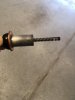
Well Frank, I would suggest you get yourself familiar with the starter before you start talking about making movies, below is the spring I'm talking about and that spring has nothing, let me say it again, nothing to do with returning the starter gear.:oldlaugh:
The spring in the pic has a spring rate of 8#/in, the preload on the spring is 2# and the working load of the spring when the solenoid is all the way in is 6#. The spring is 2.375 free length with .038 wire dia and .282 O.D.
So by shortening that spring or changing the spring to a smaller wire size will reduce those spring forces, and I'm only thinking 10%-15%

2nd thing is the little green wire on the starter solenoid that activates the solenoid when you push the start button, will keep the starter engaged as long as you keep your thumb on the switch, but most of us take our thumbs off that switch once its running. Once your thumb is off the switch the 8# spring force returns the solenoid to its rest position or disconnected, now what do you think a 6-7# spring is going to do? :oldconfused: that's what I thought:oldlaugh:

But thanks for your concerns:whoop::oldhardlaugh::cheers:
solenoid.JPG
 

BWG56

Guru
A voltage reading is a moderate indicator on what is really on tap during a load/draw. You can have two batteries, both with 12.68 and one can be junk and the other fine. It appears that with the size of these engines in conjunctions with cranking compression, that these batteries must be at the top of there game, and that means that anything borderline will result in cranking issues. The easiest way to check for a draw, is to put a test light in line with the positive cable and positive terminal. If your test light, lights up with the ignition key in the off position, then it has a draw and WILL drag that battery down over a short period of time, taking the expected life right out of it. This issue should be fixed immediately, and from what I understand, these bikes had these draw issues with the factory ESC. In the racing industry, I know for a fact, that all it takes is an engine with it's intake opening a closing events to not be where they should be, and from it creates a situation with what is known as excessive cylinder pressures. If a battery is not at the top of it's game and you happen to have an engine with excessive cylinder pressures due to design (these engines), than it's game over and a few things will occur. Those occurrences would be starter kick back, clicking or breaking the teeth off the ring gear from kick back. In the racing industry, 12 volts is very old technology. It is 16 volts. It by far is one of the greatest technology advancements brought into the industry. Now some might say, these engines are not racing engines and they don't have 14 to 17 to 1 for compression. I will tell you this, that an engine can have a compression ratio of 18 to 1 and turn over like it has no spark plugs in it. It's about intake opening and closing events that dictates cylinder pressures and not static compression. Forget that you moved the battery up .2 to .3 volts, it's not about that. It's about amperage absorption and not the increase of that .2 to .3 volts.
That's my next move to see if there is something drawing power before I change the spring.:old2:
 

Th3InfamousI

Administrator
Staff member
And just where in hell did you come up with this answer:D You are starting to sound a lot smarter than you look:)
When you are retarded ..I mean retired haha you got the time to take things apart 3-4 times and do things like measure spring load.

Hopefully some day I'll get there. A little retarded and a lot retired. I think I'm ahead of the curve on the retarded part! Whoop!

:)

Sent from my 831C using Tapatalk
 

BWG56

Guru
When you are retarded ..I mean retired haha you got the time to take things apart 3-4 times and do things like measure spring load.

Hopefully some day I'll get there. A little retarded and a lot retired. I think I'm ahead of the curve on the retarded part! Whoop!

:)

Sent from my 831C using Tapatalk
It wasn't measured, but calculated by using the spring parameters (that would be the size of it, for Frank) and the preload, then the working load.
When I road the short bus, we had a lot of time to talk cause we usually missed the stop we were supposed to get off on and rode around town a few times:oldhardlaugh:
 

FrankBDPS

Well-Known Member
Well Frank, I would suggest you get yourself familiar with the starter before you start talking about making movies, below is the spring I'm talking about and that spring has nothing, let me say it again, nothing to do with returning the starter gear.:oldlaugh:
The spring in the pic has a spring rate of 8#/in, the preload on the spring is 2# and the working load of the spring when the solenoid is all the way in is 6#. The spring is 2.375 free length with .038 wire dia and .282 O.D.
So by shortening that spring or changing the spring to a smaller wire size will reduce those spring forces, and I'm only thinking 10%-15%

2nd thing is the little green wire on the starter solenoid that activates the solenoid when you push the start button, will keep the starter engaged as long as you keep your thumb on the switch, but most of us take our thumbs off that switch once its running. Once your thumb is off the switch the 8# spring force returns the solenoid to its rest position or disconnected, now what do you think a 6-7# spring is going to do? :oldconfused: that's what I thought:oldlaugh:

But thanks for your concerns:whoop::oldhardlaugh::cheers:
View attachment 32004
Re read the first sentence of my post. I know how a starter works.
 

Vin Cent

Member
Jest so everyone knows got everything all tight battery charged had to hit that starter button like three times then the bike started it was like the starter did not have enough power let it run for a bit tried to start and it would not start like it still not getting enough power it's a new battery and a new starter all should work fine I won't to :chopper:
 

BWG56

Guru
Jest so everyone knows got everything all tight battery charged had to hit that starter button like three times then the bike started it was like the starter did not have enough power let it run for a bit tried to start and it would not start like it still not getting enough power it's a new battery and a new starter all should work fine I won't to :chopper:
Before you try to start did you give the throttle 2-3 twists? or did you pull the choke up? 3 times on the starter will draw a lot outta the battery and if you didn't ride it for 15-20 minutes, it won't fully charge the battery back up
 
Top